The Scholar Who Left: Gershom Scholem and the Illusions of Jewish Germany

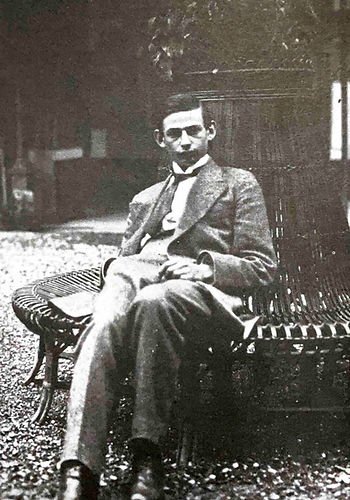
#whatireadovershabbat Gershom Scholem's From Berlin to Jerusalem: Memories of My Youth, trans. Harry Zohn (1977; Schocken Books, 1980)
In a villa on the shore of Lake Starnberg, southwest of Munich, a whimsical polymath plays host to a self-serious 22-year-old doctoral student. The student has gotten hold of a membership form for the Johann Albert Widmanstetter Society for Kabbala Research, Inc. This society is run by the charming villa owner, a millionaire’s son who has been forced by rising inflation to make a living by renting his estate to foreign visitors. He ushers this eagerly awaited, personal visitor into a library teeming with rare books and manuscripts. It is a marvelous collection.
The student is poor and dazzled, but he won’t stoop to flattery, not even if flattery will get him regular access to this tantalizing library. After they have discussed for a while the topic, Jewish mysticism, that has drawn him to the lovely lakeside home, he lets his host know what he thinks of him: that he is a dilettante—gifted, yes, but a dilettante nonetheless. “I suppose you think I am a nebbich philologist,” the host says, using a Yiddish word for pitiful. But there is no rancor in his voice. And whatever his reservations, the young student will go on to publish his first two books under the imprint of the Johann Albert Widmanstetter Society, an organization, it transpires, otherwise wholly fictional.
The man on the receiving end of his guest’s blunt assessment, Robert Eisler, a scholar whose brilliant ideas lacked for nothing except credible evidence, is known these days only to a few avid readers and the occasional History channel conspiracist. His guest, Gershom Scholem, the preeminent scholar of Jewish mysticism, who relates the encounter in his memoir From Berlin to Jerusalem: Memories of My Youth, is somewhat more famous. Yet both men belonged to the same precarious milieu. Both were products of a world soon to be destroyed: the world of German Jewry at the turn of the twentieth century. Their encounter, one of the many colorful scenes that illustrate Scholem’s book, is emblematic of this lost world...
To read the rest, see the full post on my Substack


Comments